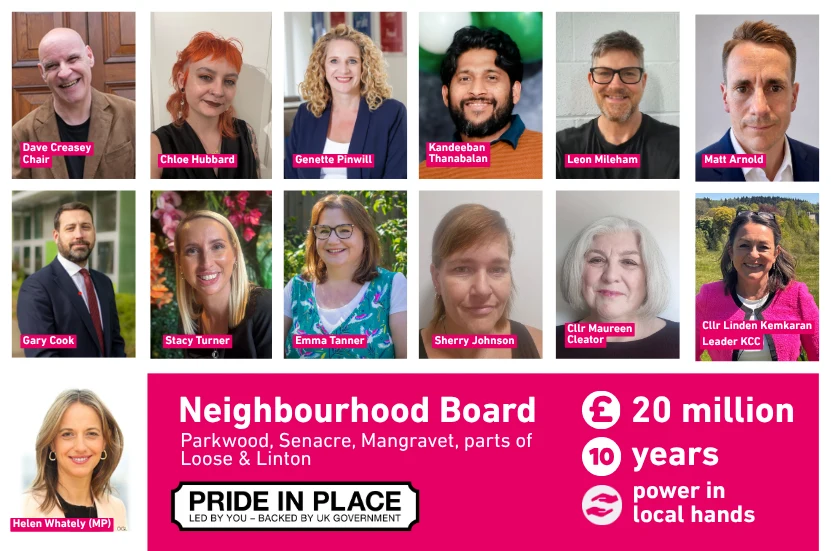

The 13-member board deciding how up to £20m is spent in Park Wood, Senacre, Shepway and Mangravet is named. Its 10-year plan goes to government by 30 November.
The people who will decide how up to £20 million is spent in Park Wood, Senacre, Shepway and Mangravet over the next ten years have been named.
Maidstone Borough Council announced the 13-member Pride in Place Neighbourhood Board on Wednesday (Maidstone Borough Council, 30 September 2026). The money comes from the UK Government. The board, not the council, leads the programme.
Its first big job has a hard deadline. A ten-year plan for the area, with a four-year investment plan, must reach the Ministry of Housing, Communities and Local Government by 30 November 2026. That date is in the papers for the board’s first meeting, held at The Vine in Shepway on 22 September (Neighbourhood Board agenda pack, 22 September 2026).
Who is on the board
The board is chaired by David Creasey, appointed as Independent Chair earlier this year. The council says he has spent more than 20 years supporting residents in Shepway, Park Wood and the surrounding areas. His own profile says that work was through The Vine Church, where he helped set up a foodbank and community café (About the Neighbourhood Board).
The other members include:
- Helen Whately, MP for Faversham and Mid Kent
- Councillor Linden Kemkaran, Leader of Kent County Council
- Councillor Maureen Cleator, Maidstone Borough Council
- Gary Cook, headteacher of New Line Learning Academy
- Emma Tanner, founder and chief executive of The Princess Project, a charity for mothers and families
- Genette Pinwill, Golding Homes, the housing association
- Matt Arnold, Skillcrown Homes, the developer
- Leon Mileham, pastor of Connect Church in Senacre
- four more residents and community representatives from Park Wood and Mangravet
David Creasey said: “Too often, things happen to communities rather than being shaped by the people who live there.” He added that he wants residents “to feel proud of where they live and confident that they can influence the future of their community.”
How much money, and when
The council and government describe the fund as “up to £20 million” over ten years. The board’s own finance paper puts the published profile at £19.6 million. About 63% is capital, for buildings and physical projects, and 37% is revenue, for running costs and services (agenda pack, item 6).
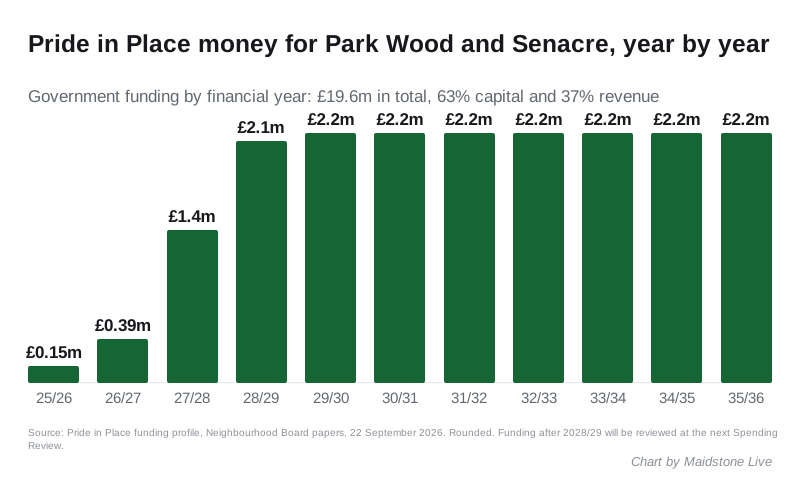
The money is back-loaded. The first years are small:
| Financial year | Revenue | Capital | Total |
|---|---|---|---|
| 2025/26 | £150,000 | none | £150,000 |
| 2026/27 | £273,000 | £118,000 | £391,000 |
| 2027/28 | £692,000 | £668,000 | £1.359m |
| 2028/29 | £692,000 | £1.455m | £2.147m |
| 2029/30 to 2035/36, each year | £767,000 | £1.455m | £2.222m |
The paper adds a caveat: funding after 2028/29 will be reviewed at the next Spending Review. So only the first three years are firm.
There are rules on spending too. The board must forecast spending at least 25% of each investment period’s money. By the end of year seven it must have spent at least half of the total.
So far, the council says, money has only been spent from an initial £150,000 “capacity” payment. That paid for community engagement and a community development manager. The council has also received £117,604 of capital and £273,462 of revenue this year. The paper says that money “remains for the Neighbourhood Board to invest”.
What it can be spent on
The council’s Pride in Place page lists eight themes the plan can cover (Pride in Place, Maidstone Borough Council):
- regeneration, high streets and heritage
- work, productivity and skills
- education and opportunity
- health and wellbeing
- community cohesion
- safety and security
- transport
- housing
Political and religious activity cannot be funded. Nor can anything a council or public body is already legally required to provide.
The next three months
The board’s papers set out the timetable. The meeting dates were proposed at the first meeting for the board to agree:
- Wednesday 21 October, 6pm: a first draft of the ten-year plan, the vision and priorities, any early “quick wins”, and recruitment of a young person (aged 18 to 25) to the board
- Tuesday 17 November, 6pm: final sign-off of the plan and the four-year investment plan
- 30 November: the deadline for sending it to government
- Spring 2027: government approval, after which the investment programme can begin
The papers also say young people’s voices are “currently underrepresented” in the engagement so far. Youth groups in the area are to be asked to help close that gap.
What it means for you
If you live in Park Wood, Senacre, Shepway or Mangravet, the next seven weeks are when your views can shape the plan. After 30 November the priorities are largely set.
The council lists three ways in:
- comment on the Pride in Place page on Let’s Talk Maidstone, which asks “What would you change?” and lets you mark places on a map
- email prideinplace@maidstone.gov.uk to join a group, ask a question or share an idea
- email the chair directly at pipchair@maidstone.gov.uk
The boundary also takes in parts of Loose and Linton, according to the board’s own papers. The council updated the boundary map in July if you want to check whether your street is in it.
For other ways to have a say in what gets built across the borough, see our guide to Maidstone planning applications.
Sources
- Maidstone Borough Council: Meet the Neighbourhood Board helping shape £20 million investment, 30 September 2026
- Pride in Place Neighbourhood Board agenda pack, 22 September 2026 (funding profile, engagement report, plan template, meeting dates, forward plan)
- Maidstone Borough Council: Pride in Place (themes, timeline, contacts)
- Maidstone Borough Council: About the Neighbourhood Board (members’ own profiles)
Have your say