

Two potholes in Mote Park and three at Penenden Heath have been filled with a material made from old clothes. Kent County Council roads are not in the trial.
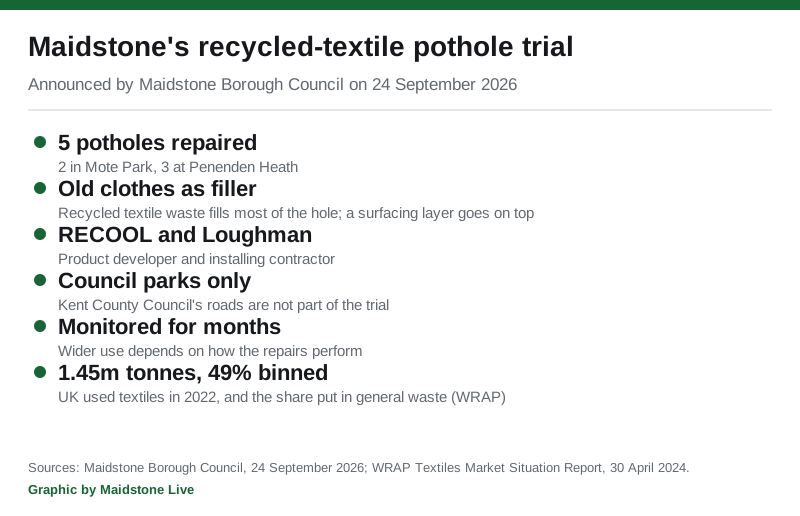
Five potholes on council land in Maidstone have been filled with a material made from old clothes. Two are in Mote Park and three are at Penenden Heath.
Maidstone Borough Council announced the trial on Wednesday 24 September. It is testing a repair product made from recycled textile waste, developed by a company called RECOOL and installed by the contractor Loughman.
The repairs are on parks and open spaces, which the borough council maintains. They are not on public roads. Potholes on roads in Maidstone are Kent County Council’s responsibility, and the county council is not part of the trial.
How the repair works
The council says the material uses recycled textile waste to fill most of the hole, with a specialist surfacing layer applied on top. It describes the product as experimental and low-carbon.
The repairs were completed recently and will be monitored over the coming months to see how they hold up under normal park use and the weather. Any wider use depends on the result.
Councillor Rachel Rodwell, the cabinet member for climate transition and nature recovery, said the pilot was “about turning that problem into an opportunity”. Councillor Clive English, the deputy leader, said the council was “keen to share what we learn with any authority interested in the results”, while noting that responsibility for potholes on public highways sits with Kent County Council.
Elise Daly of RECOOL said the company “transforms mixed textile waste into practical, lower-carbon alternatives to traditional plastic products”. Companies House lists a RECOOL Limited incorporated on 25 January 2024 with a registered office in Goudhurst, about 12 miles south of Maidstone.
The waste it is meant to use up
The council cites the Waste and Resources Action Programme, the charity known as WRAP, for the scale of the problem. WRAP’s textiles market report, published on 30 April 2024, found that the UK generated 1.45 million tonnes of used textiles in 2022. Of that, 711,000 tonnes, or 49 per cent, went into residual black bins and general waste rather than being reused or recycled.
WRAP put that at about 35 items per person a year. Of the textiles thrown in the bin, 84 per cent were incinerated with energy recovery and 11 per cent went to landfill.
Five potholes will not move those figures. The point of the trial is to find out whether the product lasts, which is why the council is monitoring it over the coming months before deciding anything.
What it means for you
- In Mote Park and at Penenden Heath, the repairs are already in place. The council has not published the exact locations. If a repair fails, the council will want to know: the parks team can be reached through the parks and play areas pages.
- A pothole on a road is a different report. Use Kent County Council’s report a problem service, not the borough council. Car parks run by the borough council are the borough’s job, and there is more on those on our parking in Maidstone page.
- Old clothes still go in a textile bank or a charity shop, not the black bin. The borough’s collection arrangements are on our bin collection days page.
- Current closures and works affecting roads in the borough are on the roadworks and travel page.
Have your say